OT cybersecurity and ISA/IEC 62443
- Outcome
- Improve visibility, segmentation and cyber resilience with controls designed around plant availability.
- Key standard
- ISA/IEC 62443-2-1 / 3-2 / 3-3
- Engagement
- Senior-led
Client challenge
Standard corporate IT security controls (such as aggressive scanning or uncoordinated reboots) can trigger PLC halts and trip critical processes, while demands for cloud analytics and remote vendor support erode boundary defences.
Why it matters operationally
Operators must defend legacy systems without compromising safety systems, deterministic cycle times or operational availability. Uncontrolled convergence creates direct pathways for enterprise ransomware to halt industrial operations.
DeepTsight capability
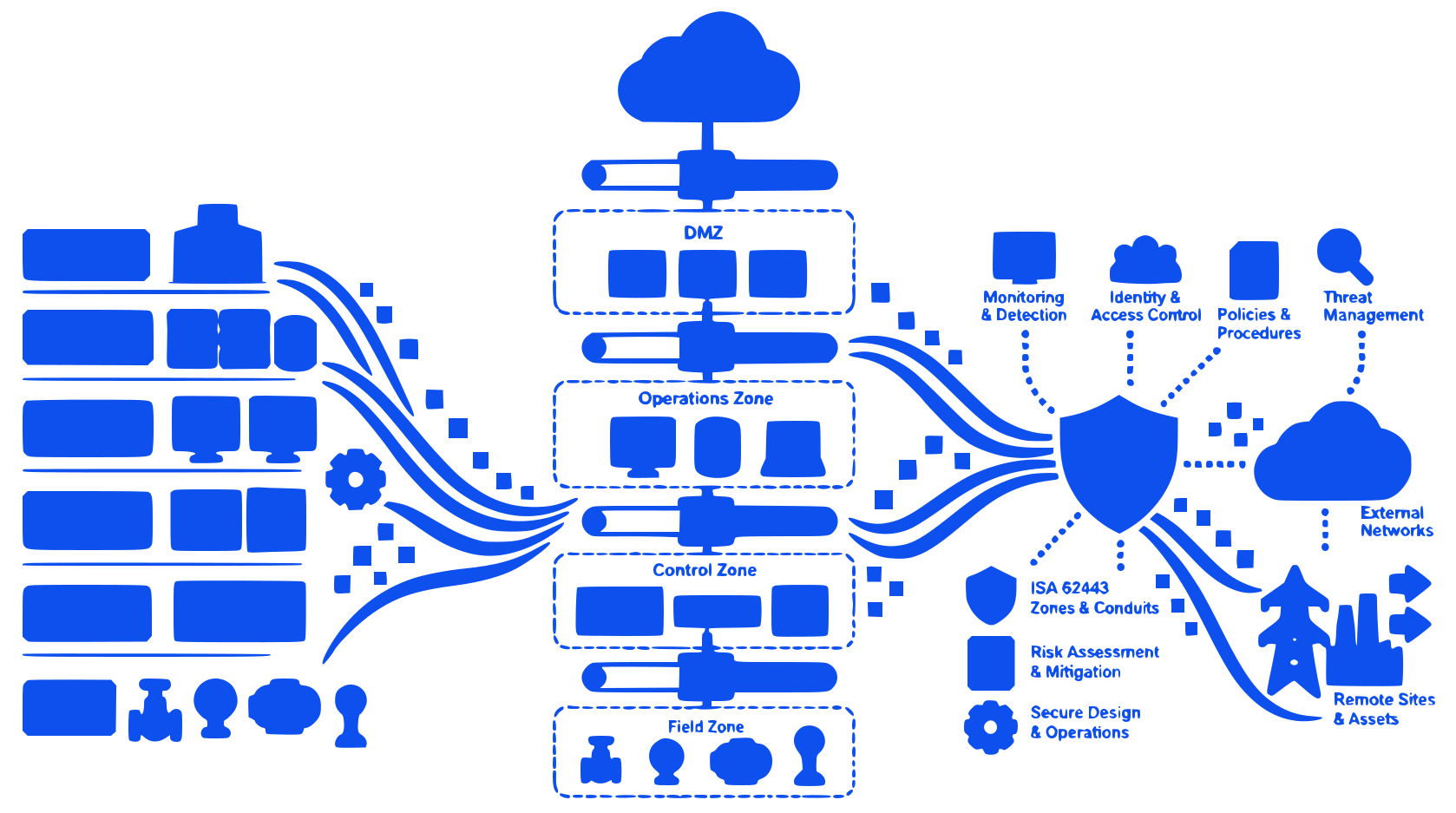
DeepTsight applies plant engineering knowledge to cyber defence, translating ISA/IEC 62443 into practical IT/OT segregation, zone and conduit designs, Level 3.5 industrial DMZ concepts, secure remote access and compensating controls for legacy or operationally constrained assets.
Typical scope and outputs
| Scope | Outputs |
|---|---|
| Risk & posture assessment |
|
| IT/OT segregation & industrial DMZ |
|
| Network architecture & hardening |
|
| Governance & lifecycle security |
|
Delivery approach
Stage 01
Passive inventory
Capture and analyse network traffic passively, with no active probes that could destabilise sensitive PLCs.
Stage 02
Zone & conduit modelling
Map industrial workflows into ISA/IEC 62443 security levels based on consequence of disruption.
Stage 03
Controlled hardening
Deploy boundary filtering, dual-homed bastion access, and authenticated industrial protocol conduits.
Stage 04
Operational assurance
Validate telemetry flows and establish continuous monitoring procedures that plant engineers can sustain.
Standards and methods
- ISA/IEC 62443-2-1 / 3-2 / 3-3
- NIST SP 800-82 Rev 3
- Purdue Enterprise Reference Architecture (PERA)